

 Tiếng Việt
 Home
Home Introduction
 Announcements
 Student Essential
 Event attendance lists
Entering university, alongside class schedules, credits, or GPA, freshmen also get acquainted with a “grading scale” that will accompany them throughout their studies: training points (conduct points). So where do these 100 points come from? Is good academic performance recognized? How to participate in programs and activities to earn points? And what should you do if you notice an inaccurate result? Let’s “pocket” this important information to stay proactive right from your first semester!
According to the Student Training Evaluation Regulations of Nguyen Tat Thanh University, training results not only reflect participation in activities but also recognize the overall learning process, compliance with regulations, community responsibility, and student contributions to the collective.
The evaluation aims to help students develop comprehensively, unleash their potential and creativity, practice life skills, and enhance work capabilities; while contributing to building the image of NTTU students who are “professionally skilled – well-equipped with skills – ethically bright – ready to dedicate”. The evaluation process must ensure objectivity, transparency, fairness, accuracy, and respect for students’ right to self-evaluation.
How are the 100 training points “divided”?
The first thing freshmen need to remember: training points are not synonymous with extracurricular activity points.
At NTTU, training results are evaluated on a 100-point scale comprising 5 content groups. The total points for each group cannot exceed the specified maximum limit.

Looking at this “point bank”, it is clear that students do not need to wait until participating in numerous programs to start accumulating points. Studying seriously, strictly complying with regulations, fully fulfilling student responsibilities, and proactively joining suitable activities all contribute to the end-of-semester training results.
Training points do not come solely from extracurricular activities
Out of the 100 total points, 20 points are reserved for academic participation awareness.
Students are recognized through registering for courses according to regulations, avoiding exam bans, complying with exam rules, academic performance, as well as participating in scientific research and academic competitions.
Specifically, the Cumulative Grade Point Average (CGPA) is converted as follows: from 3.50 – 4.00 earns 5 points; from 3.00 – 3.49 earns 4 points; from 2.50 – 2.99 earns 3 points; from 2.00 – 2.49 earns 2 points; from 1.50 – 1.99 earns 1 point; below 1.50 receives no points for this item.
Students with Faculty-level scientific research projects receive 2 points/member/project; participating in academic competitions organized by University units earns 2 points/activity.
In other words, one of the simplest ways to maintain stable training results right from freshman year is attending all classes, studying seriously, and properly following requirements during learning.
With bonus points, there are also points easily lost
A few seemingly minor things, if repeated multiple times, can directly affect your end-of-semester results.
In the academic group, arriving late, leaving early, skipping classes, or unexcused absences result in a deduction of 1 point/occurrence; joking around or being disruptive in classrooms, laboratories, or during practical sessions results in a deduction of 2 points/occurrence. Students receiving a reprimand record during exams are deducted 5 points; a warning level or higher results in a deduction of 7 points; registering for a course but having no academic result for the semester results in a deduction of 20 points.
Another “point bank”, accounting for up to 25 points, is the awareness of complying with rules, regulations, and University policies.
Violating student affairs regulations below the reprimand level—such as regulations regarding uniforms, student IDs, library, dormitories, workshops, practice rooms, etc.—results in a deduction of 1 point/occurrence. Unexcused absence from class meetings results in a deduction of 2 points/occurrence; conducting self-evaluation out of schedule results in a deduction of 5 points; failing to participate in surveys requested by the University results in a deduction of 5 points/survey type; failing to join mandatory health insurance results in a deduction of 5 points/semester.
Regulations also state deduction levels for failure to declare or dishonestly declaring off-campus residence, failing to submit full admission files, failing to fulfill tuition fee obligations, participating in unauthorized activities on campus, or engaging in acts affecting security and order.
Students disciplined with a reprimand are deducted 15 points/semester; disciplined with a warning are deducted 25 points/semester.
Therefore, maintaining good training points sometimes starts not from massive actions, but from basic habits: being punctual, following rules, and taking responsibility for your own studies.
What activities can students accumulate points from?
Beside academics, political, social, cultural, artistic, sports programs, volunteer activities, and crime/social evils prevention form an important part of training results, up to a maximum of 20 points.
According to the point frame, students attending University-wide programs earn 1 point/activity; participating directly in programs earns 2 points/activity. Students commended for achievements at the University level or University Youth Union – Student Association level receive 3 points/certificate of merit.
Active members of clubs, teams, or movement/volunteer groups under University units receive 5 points/participating unit.
For public service, volunteer, and social work activities, students holding certificates earn 2 points/certificate; commended at the University or ward/commune level earn 3 points/certificate of merit; commended at the provincial, municipal, regional, or higher level earn 4 points/certificate of merit. Participating in propaganda, crime prevention, and social evils prevention earns 2 points/activity.
Conversely, failing to comply with requirements to participate in designated activities or engaging in behavior that affects organizational work—such as registering then arbitrarily quitting, non-compliance with rules, cheating in competitions/performances—will incur corresponding point deductions.
Participating is not enough, remember to verify your recorded points
This is a detail freshmen easily overlook.
For movement and extracurricular programs/activities eligible for training points, point recording must follow the correct procedure.
One week prior to the event date, the organizing unit sends the approved plan to the Department of Student Affairs to request point awards. Within 1 week after the activity ends, the unit submits the list of participating students using template BM-01RL (both soft and hard copies), certified by the head of the unit.
Upon receiving complete files, the Department of Student Affairs updates the list on the training point management system within 03 working days and announces the credited activities on students’ personal portals.
If lists are submitted past the deadline, missing documentation, or using incorrect templates, they will not be accepted for point calculations in that semester.
Therefore, after joining a program, students should proactively check their personal accounts to ensure results have been fully updated.
Community responsibility accounts for up to 25 points
One of the two highest-weighted groups is civic awareness in community relations, capped at 25 points.
Students properly observing Party guidelines, State policies, and laws receive 15 points; properly fulfilling off-campus or dorm resident requirements receive 5 points.
Students holding voluntary blood donation certificates in the semester receive 2 points/time; commended/praised at the University level for social work, maintaining political security and social order receive 3 points; participating in social activities recognized by domestic or international agencies receive 3 points. Acts of helping people in distress/hardship that are recognized, praised, or awarded can be credited from 2 – 10 points.
Cases of causing discord, internal disunity in class/faculty with documented warnings; violating laws, traffic safety, social order; disturbing security/order at residential areas… incur specific point deductions according to Regulations.
Class officers, Youth Union – Student Association cadres, and outstanding achievements are recognized
The final group has a maximum of 10 points, dedicated to class leadership, organizations, or special achievements in study and training.
Vice monitors, deputy secretaries of Youth Union branches, vice presidents of clubs/teams receive 4 points; class monitors, secretaries of Youth Union branches, presidents of clubs/teams receive 5 points.
Executive Committee members of Faculty Youth Unions, Faculty Student Association branches, or University-level club/team management boards completing tasks receive 6 points. Certain University-level or Faculty-level leadership positions completing tasks receive 8 points. Other class officer roles completing tasks receive 3 points.
Students receiving University-level certificates of merit for Youth Union – Student Association work or special achievements in study/training earn 3 points/certificate; provincial/municipal level certificates earn 4 points/certificate; achieving special milestones in study and training earns 3 points/activity.
For class officers, Youth Union – Student Association cadres, or Party cell committee members who are absent from meetings without valid reasons, 1 point is deducted per occurrence; failing to complete assigned tasks results in a 5-point deduction/semester.
Scientific research, Youth Union – Association, “Student of 5 Merits”… earn additional points
Beyond the standard frame, Regulations also provide special recognition for students achieving outstanding results.
Students praised/awarded in Class Management Board activities can receive an additional 2 – 10 points/semester. Outstanding Youth Union members at the University level get +5 points/title; Elite Youth Union members at the University level get +7 points/title.
Students with published articles in scientific journals or University publications get +5 points/article; delivering presentations or thematic reports at University scientific conferences gets +8 points/article. Student teams with University-level scientific research projects get a total of +10 points/project, with the project leader deciding point distribution among members.
Certain achievements may also qualify a student for a one-level upgrade in their semester training rating, such as winning prizes in academic, scientific research, political-social, cultural, artistic, or sports competitions at provincial/municipal, regional, or national levels; receiving commendations at various levels for social work, law enforcement/protection, or saving lives; receiving Central-level certificates of merit for Youth Union – Association work; achieving the University-level “Student of 5 Merits” title or equivalent.
If a student already achieved an “Excellent” rating in that semester, the upgrade result will be reserved for the following semester.
80 points is Good, how much is needed for Excellent?
After aggregation, training results are classified into 6 levels:
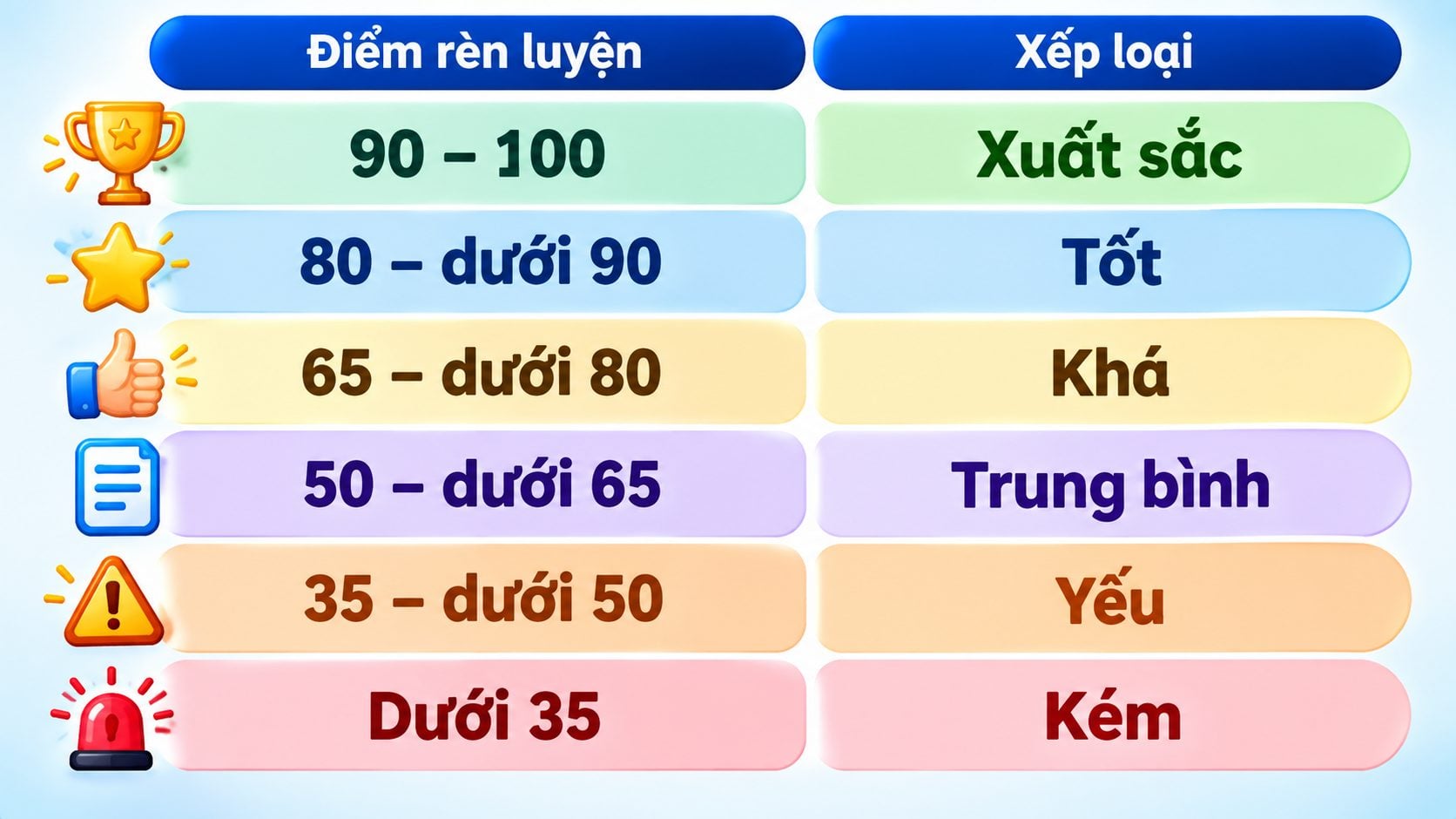
There is one vital piece of information freshmen must remember: students who fail to conduct self-evaluation will receive 0 points and be classified as Poor.
During disciplinary periods at the reprimand level, training results cannot exceed “Fair”; if disciplined at the warning level, training results cannot exceed “Average”. Students suspended or forced to drop out will not have training results evaluated during the corresponding period per regulations.
Not only individuals, but class collectives are also evaluated based on the proportion of students achieving Excellent, Good, and Fair ratings, as well as the status of students rated Weak or Poor.
Don’t wait until the end of the term to check your points
During the semester, the University updates training results on personal accounts for students to monitor and use as a basis for self-evaluation.
Students need to proactively check both bonus and deduction points. If you notice content requiring addition or adjustment, contact the relevant unit within the prescribed timeframe for verification and resolution.
At the end of the semester, evaluation follows a structured process: updating and reviewing data; conducting class meetings; Faculty-level Board review; University-level Board aggregation and resolution of special cases; updating results onto the system, locking scores, and publishing to students.
During class meetings, the academic advisor chairs; the monitor or vice monitor serves as secretary. Point levels for each student are approved only with over half of the class collective’s consent; students sign for confirmation, and minutes must be recorded using prescribed forms.
What to do if you discover incorrect scores?
Students have the right to request a review of their training results.
If results have not been locked, students fill out form BM-05RL, attach it to the class meeting minutes, and submit it to the Faculty Managing Students. The Faculty aggregates and forwards it to the Standing Committee of the Training Evaluation Board to coordinate with related units for review and adjustments if needed.
If results have been locked, students use form BM-05RL, attach evidence, and submit directly to the Department of Student Affairs within 07 working days from the date results were locked.
After this deadline, the University will not resolve complaints regarding training results for that semester.
Therefore, a simple “tip” is: don’t wait until you need to use your training results to open the system and check.
Are training points important? Yes, absolutely!
Training results for each semester and academic year are stored in student management records and serve as a basis for the University to consider scholarships, tuition fee reductions, commendations – discipline, suspension, dorm residency, and other preferential policies (if any).
Entire-course training results are archived in files, used as a basis for graduation evaluation, and recorded in the final student evaluation transcript.
Students with excellent training results in an academic year are considered for University commendations and rewards. Students with entire-course training results rated Excellent receive certificates of merit from the President along with monetary rewards per regulations.
Conversely, students rated Weak or Poor for 2 consecutive semesters will be considered for disciplinary suspension for at least 1 semester in the following term. If they continue to receive Weak or Poor ratings for 2 consecutive semesters a second time, they will be considered for forced withdrawal per Regulations.
Special cases are also clearly regulated
Evaluation targets students currently studying at Nguyen Tat Thanh University. Additionally, Regulations provide specific guidance for students behind schedule, graduating early, taking temporary leave, studying dual degree programs, or transferring universities.
Students taking temporary leave have their training results reserved and resume evaluation upon return. Students graduating early have their entire-course training results calculated up to the graduation point. Transferring students, with consent from Presidents of both higher education institutions, retain results from their former school and continue evaluations in subsequent semesters.
For students with disabilities, orphans, or those facing severe economic hardships unable to participate in certain general activities, providing specific documentation will allow for priority consideration, encouragement, and bonus points per regulations.
5 key forms to know when tracking training points
The evaluation process uses 5 main forms: BM-01RL is the list of students participating in activities; BM-02RL is the class summary score sheet; BM-03RL is the class meeting minutes for point evaluation; BM-04RL is the Faculty summary of student results per class; BM-05RL is the application for training result review.
For freshmen, the easiest 2 forms to remember are: BM-01RL for recording student activity participation, and BM-05RL for requesting result re-evaluations.
The “formula” to maintain good training points from freshman year
There is no need to turn your freshman year into a race to “hunt” as many activities as possible. Training points are formed through a continuous process: serious learning – strict adherence to rules – proactive participation in suitable programs – responsibility toward collective and community – regular result checks – completing self-evaluations on time.
100 training points are therefore not a number to “hoard” quickly at the end of the term, but a way to recognize what students have learned, experienced, and contributed in the university environment.
So, instead of waiting until the end of the semester to ask “Where are my training points?”, NTTU freshmen can start with small steps today: study a bit better, be a bit more proactive, and remember to check your “point bank” regularly.
Nguyen Tat Thanh University