
 Tiếng Việt
 Home
Home Introduction
 Announcements
 Student Essential
 Event attendance lists
The invention titled “Apparatus, system, and methods for cultivating green micro algae (H. pluvialis) and for harvesting Astaxanthin therefrom” by NTTU scientists was recognized as an international patent by the United States Patent and Trademark Office (USPTO) on December 23, 2025.
The research team from the Institute of Hi-Technology, Nguyen Tat Thanh University, includes Assoc. Prof. Tran Viet Cuong, Dr. Huynh Tran My Hoa, Dr. Nguyen Hoang Hung, MSc. Nguyen Luong Hieu Hoa, MSc. Nguyen Thi Bich Ngoc, and Dr. Vu Van Van. Starting from a microalgae strain transferred within the framework of Vietnam – Korea cooperation, the research team has step-by-step improved the cultivation system, controlled the growth process, and enhanced the accumulation capacity of Astaxanthin from the microalgae Haematococcus pluvialis.
When the challenge is more than just cultivating algae
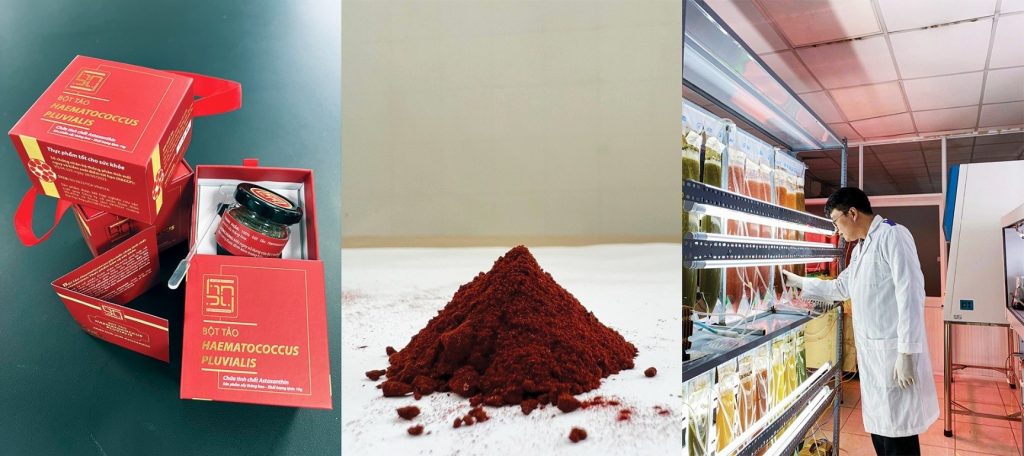
Astaxanthin is a natural carotenoid pigment, often recognized by its characteristic orange-red color in certain marine organisms, microalgae, and yeast. In the field of biotechnology, Haematococcus pluvialis is considered one of the most notable microalgae sources for extracting natural Astaxanthin. However, cultivating this microalgae species is not simple. To create stable biomass, limit bacterial contamination, control environmental conditions, and promote high levels of active ingredient accumulation, the research team had to simultaneously solve many problems regarding equipment, operating procedures, investment costs, and scalability.
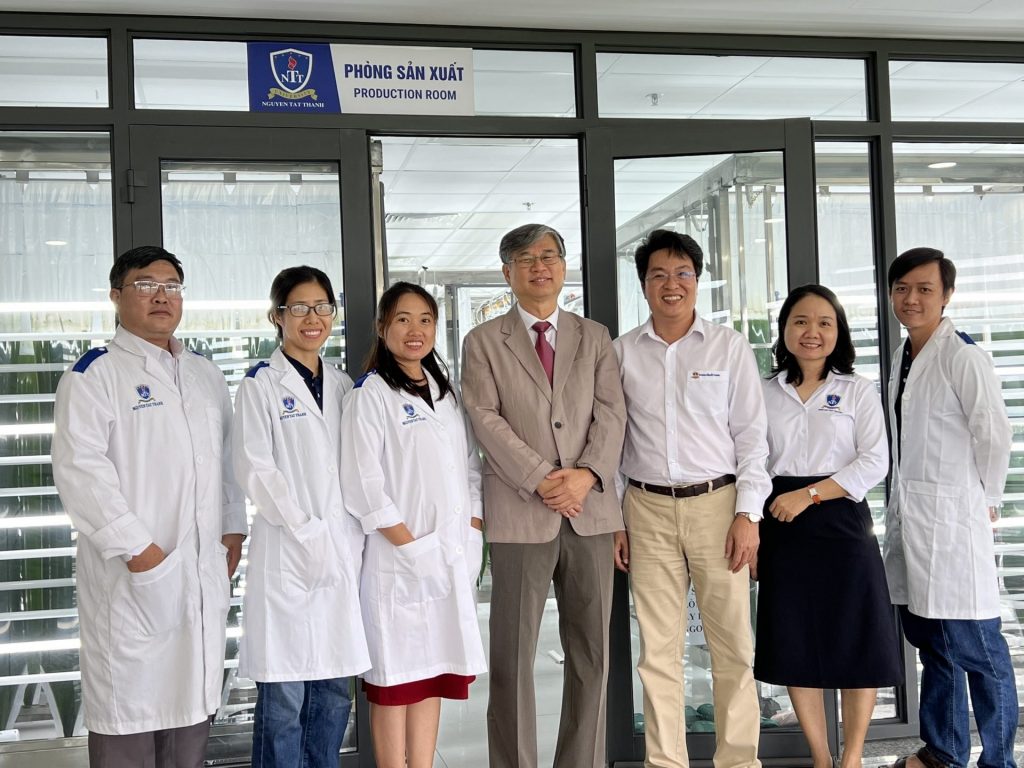
Prof. Chang-Hee Hong (center) and Assoc. Prof. Tran Viet Cuong – Deputy Director of the Institute of Hi-Technology, NTTU (next to the right) with the research team.
In 2020, the Vietnam – Korea Center for Research, Development and Technology Transfer, under the Institute of Hi-Technology at Nguyen Tat Thanh University, received cultivation technology and the Haematococcus pluvialis microalgae strain from Professor Chang-Hee Hong, Jeonbuk National University, South Korea. This cooperative foundation originated not only from international academic relations but also from trust in the research capacity, facilities, and applied orientation of Nguyen Tat Thanh University.
In the initial stage, the algae cultivation system was deployed based on a tubular photobioreactor model, similar to some popular systems worldwide. However, when applied to actual conditions in Vietnam, the research team identified many limitations: difficulties in controlling water sources, the risk of contamination leading to massive algae death across the entire system, high installation costs, and scalability that was not truly suitable for commercialization.
The noteworthy point is that the research team did not stop at operating the transferred technology. They asked a more fundamental question: how can a potential algae strain adapt to production conditions in Vietnam, create higher-value active ingredients, while still ensuring reasonable costs and the ability to move closer to practical application?
Improving the cultivation system: from tubular systems to independent hanging bag modules
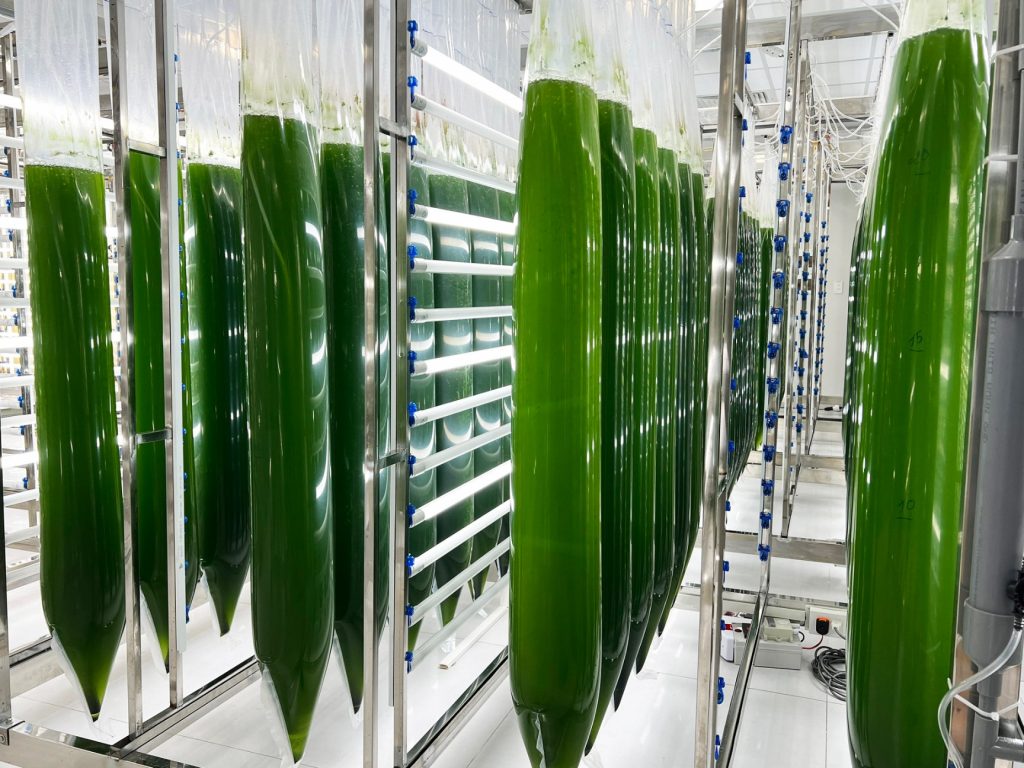
After years of research and testing, the team of Assoc. Prof. Tran Viet Cuong developed a new approach: instead of relying on tubular systems, the team switched to a vertical hanging plastic bag system, operating independently as separate units. This is a significant change in both technical and economic terms.
With tubular systems, if one area becomes contaminated, the risk of spread can affect the entire system. Meanwhile, with the independent hanging bag structure, if one bag encounters a problem, the research team can treat it locally without stopping or cleaning the entire system. This approach helps reduce operational risks, save processing time, and increase flexibility when deploying at various scales.
According to information released in 2024, the research team developed the system from 5-liter bags to fixed 25-liter bags, and subsequently improved them into modular units that can be assembled and moved. Additionally, the air and CO₂ mixing systems were adjusted to support the growth process and the accumulation of active ingredients in the algae. These technical details show that the strength of the invention does not lie in a single piece of equipment, but in the way the research team reorganized the entire cultivation system, from physical structure and operating conditions to quality control capabilities.
Commercialization significance: reducing costs to bring technology to market
One of the most notable points of this story is the cost factor. When the new cultivation system was perfected, the production cost of Astaxanthin decreased significantly, from about 1,000 USD/kg to over 300 USD/kg in 2024. This figure demonstrates the right direction; if one wants to commercialize a high-value biological active ingredient, the research team cannot only care about the content of the active ingredient but must simultaneously solve the problems of yield, cost, stability, and scalability.
In Vietnam, the gap between research results and the market often lies at the “intersection” between laboratories and businesses. A promising technology may still face difficulties if businesses do not have clear demand, do not have suitable production lines, are not familiar with new materials, or if the consumer market is not sufficiently aware. The story of NTTU’s Astaxanthin is no exception. The research team has worked with several domestic pharmaceutical companies and has been connected with high-tech partners in South Korea to find outlets for the product.
The positive point is that this invention does not stop at the “idea” level. It has gone through the process of strain transfer, system testing, equipment improvement, cultivation condition optimization, and application direction development. That structure is very close to the spirit of R&D-B, meaning research and development must lead to business, application, and creating actual value. For applied-oriented universities like NTTU, scientific research is not just for publication, but also to form intellectual property, core technologies, and opportunities for business cooperation.
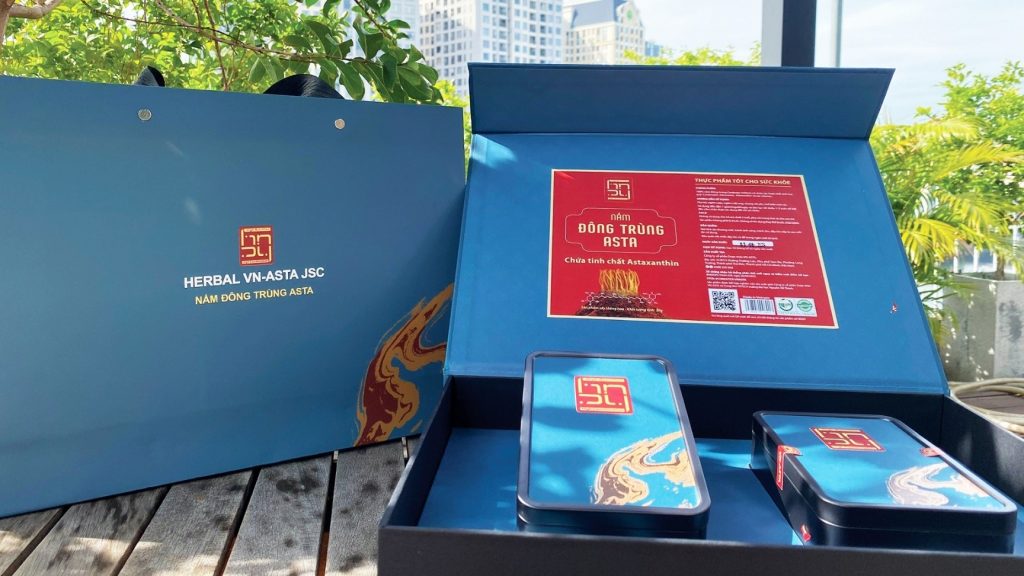
‘Dong trung – Asta’ is the first product in the world to combine the benefits of Astaxanthin into Cordyceps militaris for consumers.
NTTU’s uniqueness: from international cooperation to technological autonomy
The invention regarding the H. pluvialis microalgae cultivation and Astaxanthin harvesting system shows a clear direction in the scientific and technological development strategy of Nguyen Tat Thanh University: proactively receiving international knowledge but not stopping at the role of applying transferred technology. From the initial cooperation foundation, the research team has step-by-step mastered the process, identified bottlenecks when implementing under conditions in Vietnam, and improved the system in a direction more suitable for production practice, quality control, and scalability.
The significance of the invention therefore does not only lie in an algae cultivation system or a high-value biological active ingredient but also in the capacity to turn transferred knowledge into the university’s own intellectual property. From research results in the laboratory, the author team has developed a solution capable of connecting with businesses, opening up prospects for proactively securing natural biological materials in Vietnam and creating premises for application directions in health protection foods, cosmetics, pharmaceuticals, and high-tech agriculture.
In the context of universities increasingly expected to become centers of the innovation ecosystem, this achievement is a testament to NTTU’s role in creating technology, protecting intellectual property, and promoting the commercialization of research results. This is also the foundation for the university to continue affirming its direction of developing applied research, linking science and technology with practical needs, and contributing to sustainable development.
Ho Quy