
 Tiếng Việt
 Home
Home Introduction
 Announcements
 Student Essential
 Event attendance lists
Instead of waiting until their final year to gain hands-on professional experience, first-year Educational Technology students from the Faculty of Applied Sciences and Technology at Nguyen Tat Thanh University have directly conducted scientific research, designed digital learning materials, and tested their products in preschool and primary school settings right from their second semester.
Through five projects implemented at the Anglo-Vietnamese-American (AVAS) Kindergarten and Primary School, NTTU students have steadily demonstrated their capacity to bridge technology with real-world learning needs, while cultivating a professional mindset as educators in the digital era.
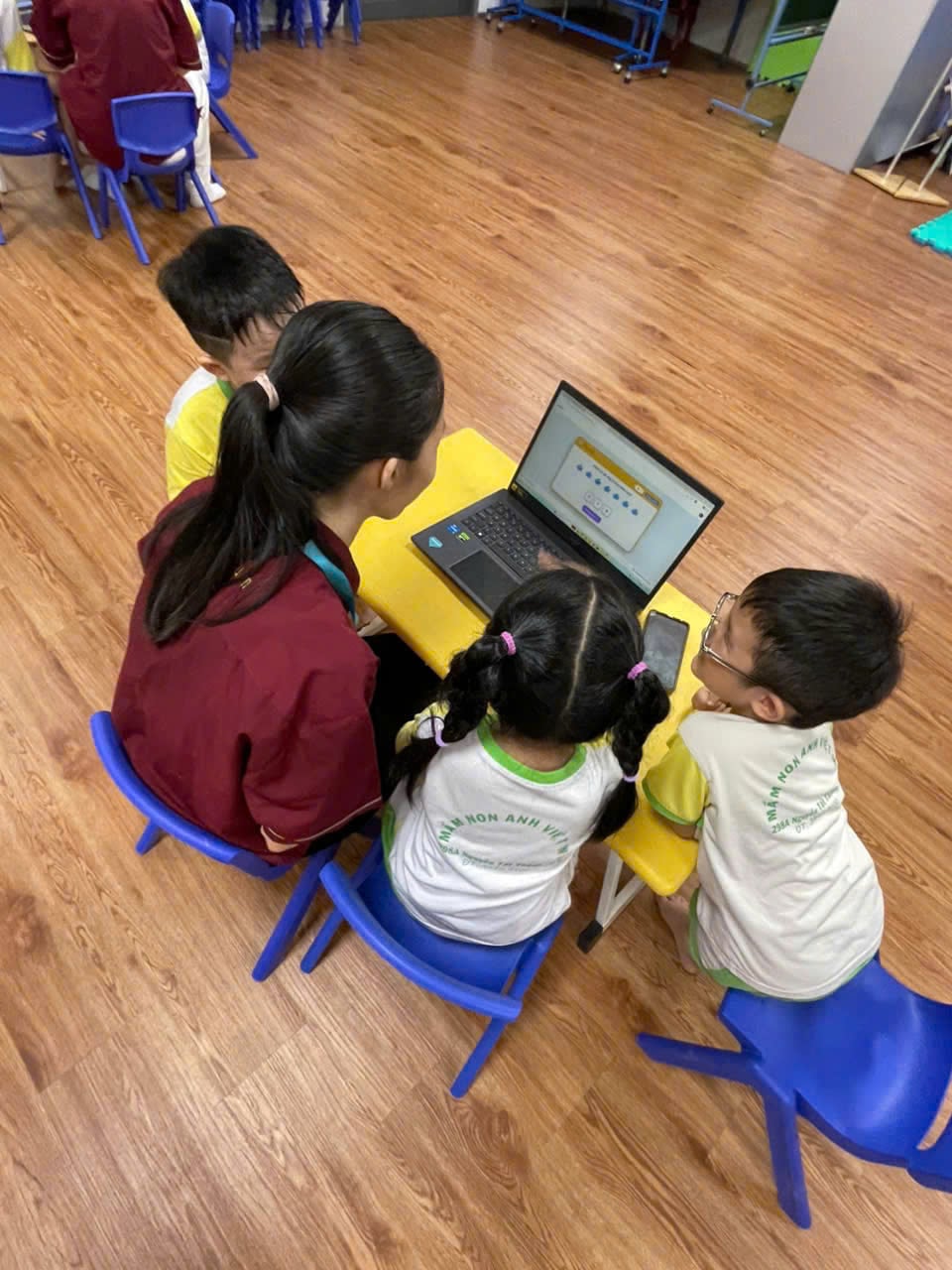
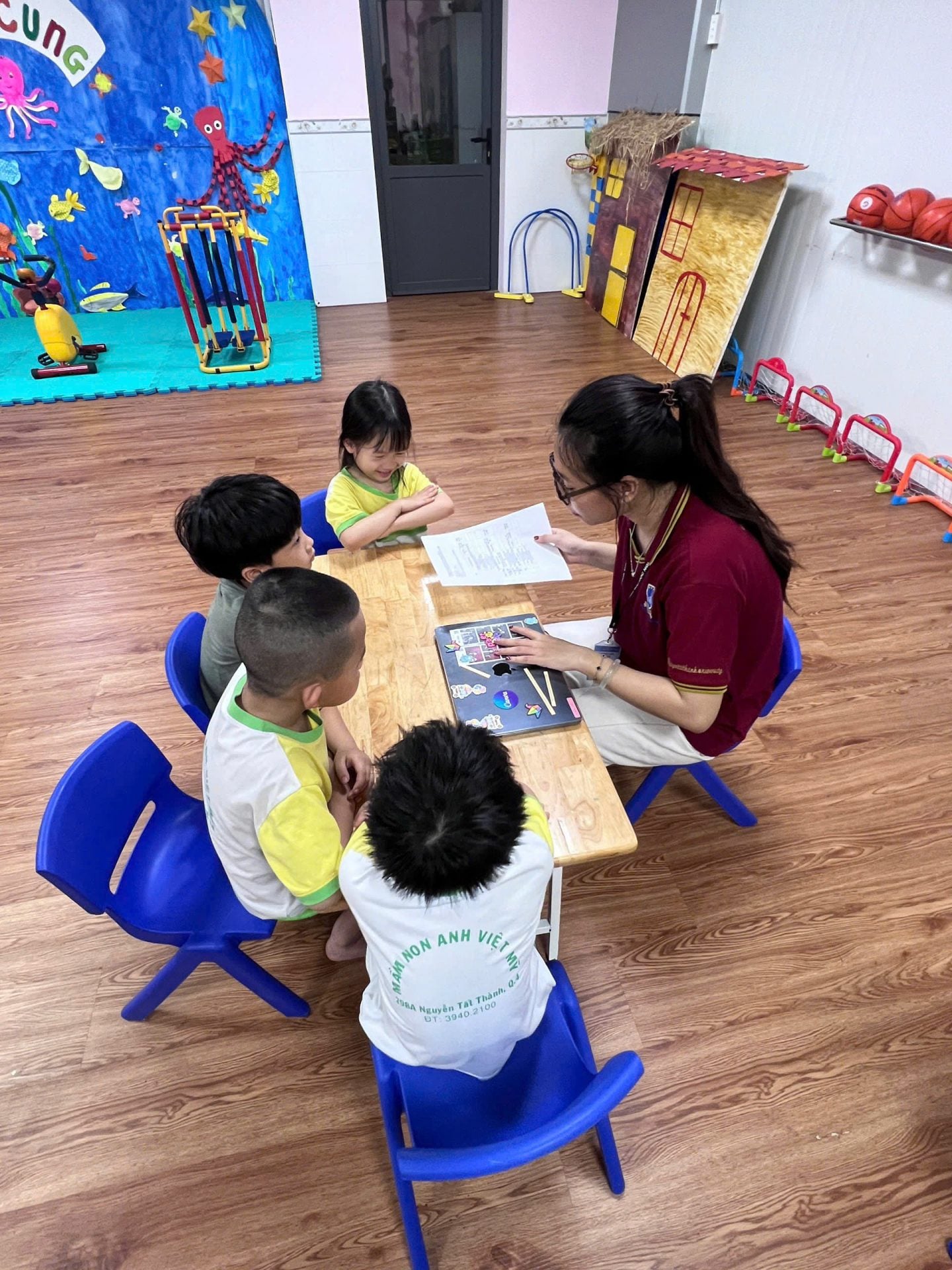
Preschoolers observe and interact with digital learning materials under the guidance of NTTU students
From the Lecture Hall to Real Classrooms
Scientific research in universities is traditionally viewed as an activity reserved for third- or fourth-year students who have already built a solid foundation of specialized knowledge. However, at the Faculty of Applied Sciences and Technology of Nguyen Tat Thanh University, Educational Technology students are guided to engage with research from the very beginning.
Starting in the second semester of their first year, students are encouraged to observe classroom issues, identify learners’ practical needs, and transform them into testable digital products. This approach ensures that research is not confined to theoretical models or illustrative concepts, but is instead geared toward practical application in actual educational environments.
In the recent research phase, student groups executed 5 projects tailored for preschoolers aged 5–6 and primary school students from grades 3 to 5. The products were trialed directly at the Anglo-Vietnamese-American Kindergarten and Primary School, backed by the professional guidance of university lecturers and the cooperation of the school’s teachers.
The research topics were developed to closely align with the psychological and physiological traits of the learners, while aiming to foster essential competencies outlined in the new general education curriculum. Within the collaborative competency-building group, projects focused on designing interactive group-based digital games, which included a digital game application for Mathematics targeting 5–6-year-old preschoolers and a project enhancing collaborative skills for 4th graders through digital tools.
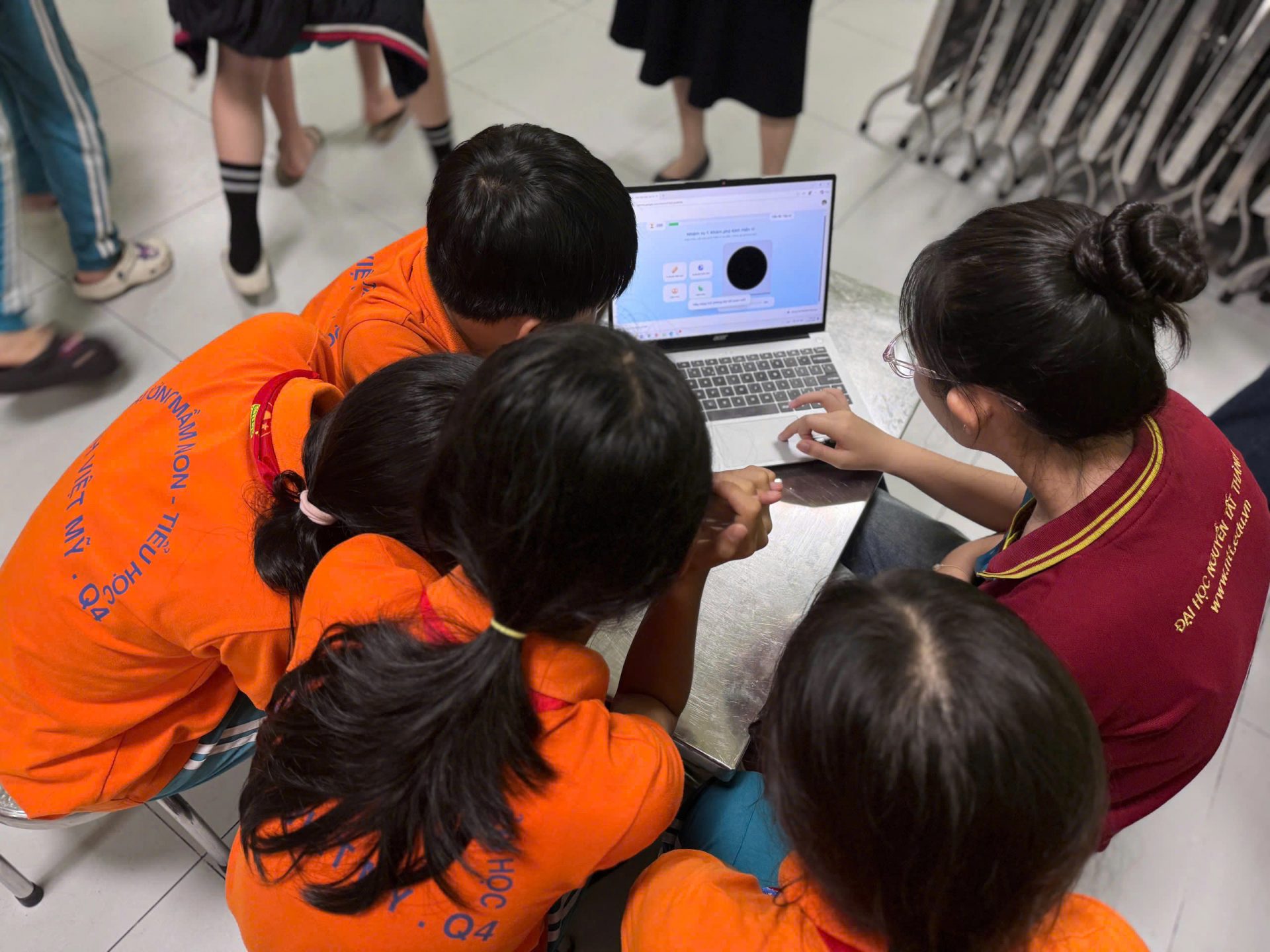
Through experiential activities on digital platforms, students are encouraged to discuss, observe, and find solutions to learning tasks together
Instead of having children use devices individually, the games were structured to require learners to discuss, agree on solutions, and support each other to accomplish tasks. Consequently, technology functions not just as a medium for presenting knowledge, but as a bridge to cultivate communication, cooperation, and sharing skills in learning.
In the digital learning materials and visual thinking development category, students implemented a project designing interactive digital resources on Microsoft PowerPoint to help 5–6-year-old preschoolers recognize alphabet letters; alongside a visual digital game application to help 3rd graders memorize English vocabulary more effectively.
Transforming a familiar presentation software, the student group developed Microsoft PowerPoint into a learning space complete with audio, visuals, and interactive effects. Letters were connected to object images, pronunciations, and real-time feedback activities, enabling children to engage with the material using multiple senses rather than just passively observing and repeating.
For 5th graders, a project designing digital games for exploration-experiential activities in Natural Sciences introduced an innovative approach to theoretical content. Lessons were reframed into exploratory missions, prompting students to actively observe, deduce, and interact with the knowledge through a digital landscape.
Observations from the trial sessions at the Anglo-Vietnamese-American Kindergarten and Primary School showed that the learning atmosphere turned highly enthusiastic as pupils accessed the digital products designed by NTTU students. The young learners did not just answer questions and interact with the screens; they actively discussed, worked in teams, and provided direct feedback on the lesson content.
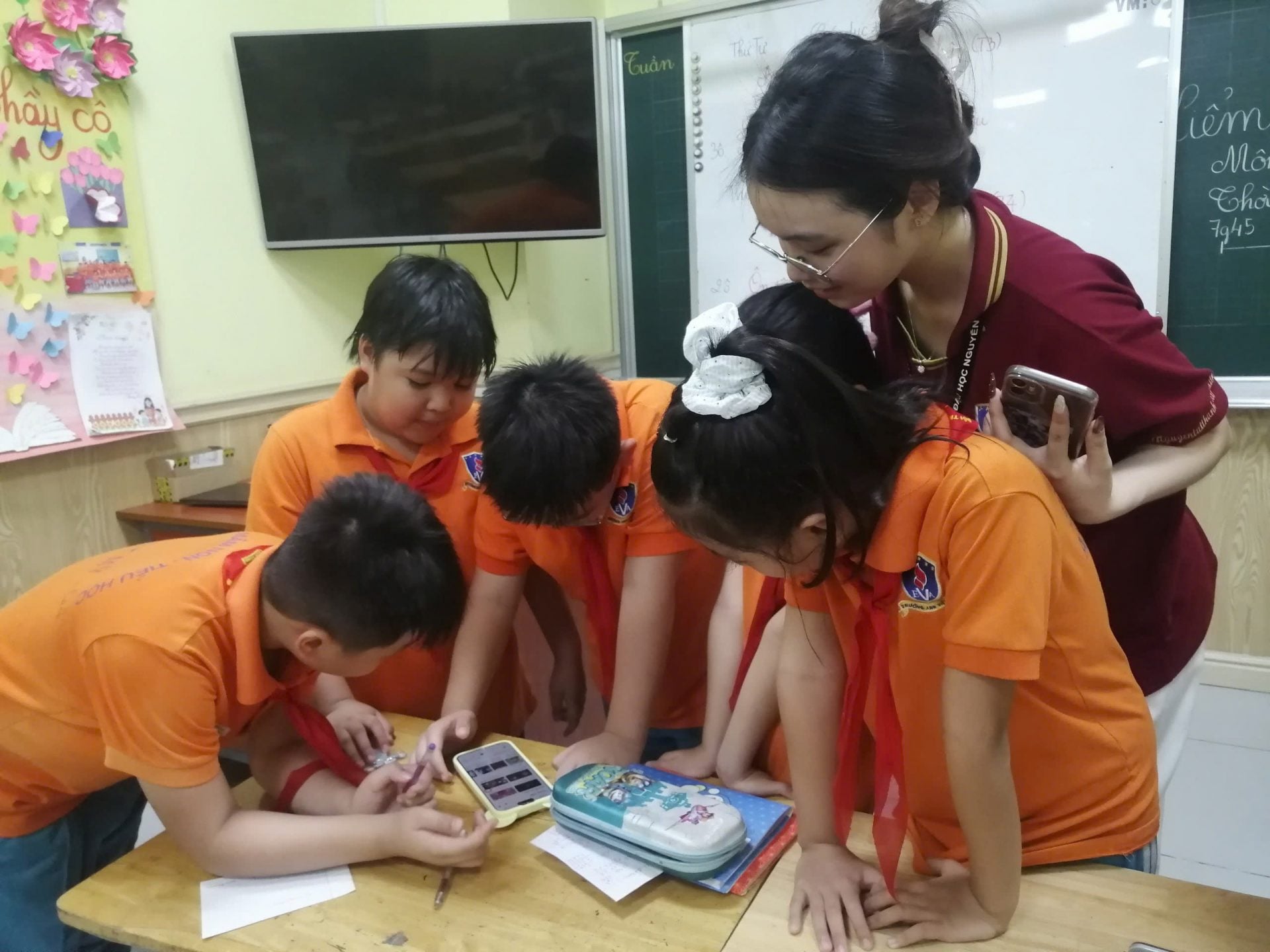
Digital learning activities are organized in groups, encouraging students to actively interact with lesson content and discuss with peers
Particularly in the kindergarten segment, two projects focused on early-life milestones: logical-mathematical thinking and language acquisition. With the digital game supporting cooperation in Math, children were encouraged to observe, discuss, and deliver answers collectively on a shared screen.
Through this activity, children not only practiced counting and comparing quantities but also learned to wait for their turn, listen to their friends’ opinions, and explain their choices. Meanwhile, the interactive PowerPoint materials made letter recognition feel much closer to home by delivering letters through lively animations, motion effects, and audio pronunciations.
Early Research Lays a Professional Foundation for Educational Technology Students
The value of this testing phase lies not just in the finalized digital products, but in the process where students directly observe children’s learning behaviors, listen to teacher feedback, and adapt their products to real-world scenarios.
From a minor interface glitch, an inappropriate activity duration, or an incorrect difficulty level for a question, every detail became data for students to re-evaluate their designs. These experiences helped them realize that an educational technology product is truly valuable only when it accommodates the learner, assists the teacher, and addresses an actual classroom need.
The students’ concentration, excitement, and active participation during the activities served as positive indicators of the projects’ initial efficacy. At the same time, it provides the momentum for university students to keep refining their products, enhancing interactivity, and expanding applicability in upcoming stages.
Enabling students to research and implement products starting from their first year is a core practical training strategy of the Educational Technology program under the Faculty of Applied Sciences and Technology at Nguyen Tat Thanh University.
The Educational Technology major does not merely train individuals to use digital tools; it aims to develop a workforce capable of integrating technology, educational science, and the practical needs of learners. Students are equipped with mindsets for material design, digital content development, the organization of interactive learning activities, and the assessment of technological application in education.
Through these initial projects, first-year students have early on recognized the dual role of an Educational Technology professional: understanding technology while deeply understanding the learner and the pedagogical context. This forms an essential foundation for them to continue building research capacity, innovating products, and meeting the demands of digital transformation in education.
The trial results at the Anglo-Vietnamese-American Kindergarten and Primary School mark not only the first milestone in these students’ scientific research journeys but also highlight the proactive, experimental, and classroom-ready spirit of Nguyen Tat Thanh University students.
Written and photographed by: Dr. Bui Thi Viet
Faculty of Applied Sciences and Technology – Nguyen Tat Thanh University